
Catering Vehicle Insurance: Why the Right Cover Matters for Your Mobile Catering Business

Catering vehicle insurance is an important consideration for anyone operating a mobile food or drink business. Whether you’re launching a new street food concept, expanding an established business or taking your brand on the road, your catering vehicle can quickly become one of the most valuable assets within your operation.

Alongside the design, equipment, menu and branding, insurance shouldn’t be something that’s left until the last minute. Having appropriate cover starts with understanding exactly what needs protecting and making sure your insurer understands what your vehicle is, how it has been converted and how it will be used.

Why Catering Vehicle Insurance Is Different

A professionally converted catering vehicle is very different from a standard commercial van.

Depending on the build, it could contain thousands of pounds worth of specialist equipment, commercial electrical systems, LPG installations, extraction equipment, refrigeration, water systems, stainless-steel fabrication and bespoke fixtures. Then there’s the value of the catering conversion itself.

For this reason, when arranging catering vehicle insurance, it’s important to make sure your insurer understands exactly what they are being asked to cover.

A policy designed for an ordinary commercial vehicle may not necessarily reflect the requirements of a purpose-built mobile catering business. The modifications, equipment and commercial use of the vehicle should all be discussed with your chosen insurance provider.

Think Beyond the Catering Vehicle

The vehicle itself is only one part of the picture. Depending on your business and how you operate, there may be several areas of insurance to consider, including:

  • The vehicle and its catering conversion
  • Catering and commercial kitchen equipment
  • Public liability
  • Product liability
  • Employers’ liability where applicable
  • Stock and contents
  • Business interruption
  • Event and trading requirements
  • Breakdown or recovery provision

Every mobile catering business is different, so appropriate cover will depend on factors such as the vehicle, installed equipment, trading locations, employees and the type of food or drink operation you’re running.

Tell Your Insurer About Your Catering Vehicle Conversion

One of the most important things you can do when arranging catering vehicle insurance is give your insurer accurate information about the vehicle and its conversion.

A professional catering conversion can involve substantial modifications to the original vehicle, including service hatches, electrical installations, LPG systems, extraction, plumbing, fabrication and permanently installed commercial catering equipment.

Your insurer should be made aware of relevant modifications and the intended use of the vehicle so they can advise you on appropriate cover.

Keeping documentation relating to the build, installed equipment and relevant electrical or gas certification can also make it much easier to provide accurate information about your catering vehicle when arranging insurance.

Don’t Leave Catering Vehicle Insurance Until Handover Day

We recommend considering insurance before your catering vehicle is ready to collect.

Starting the conversation early gives you time to explain the vehicle specification, understand what information your chosen insurer requires and arrange suitable cover before the vehicle enters service.

There are also wider legal requirements that mobile catering businesses may need to consider. The UK Government provides guidance on Employers’ Liability insurance, including information about when businesses employing staff are required to have cover.

Insurance requirements can vary considerably between businesses, so it’s always important to discuss your individual operation with an appropriate insurance provider rather than assuming a standard policy will cover everything associated with your catering vehicle.

Building More Than Just Catering Vehicles

At Bespoke Catering Vehicles, we want the journey from initial concept through to operating your finished vehicle to be as straightforward as possible.

We design and manufacture bespoke catering vans, trailers and container conversions, with each project developed around the requirements of the individual business.

That means thinking beyond simply building the vehicle. We want our customers to have the information and support they need as they move from the build process into operating their new mobile catering business.

Something New Is Coming…

We’re currently working behind the scenes on an exciting new development for Bespoke Catering Vehicles customers.

Our aim is to make another important part of getting your catering vehicle on the road simpler – and potentially more cost-effective.

We can’t reveal the details just yet, but we’ll be announcing more very soon.

Watch this space.

A catering van conversion is one of the most flexible ways to launch a mobile food business. Whether you’re serving coffee, street food, desserts, or full kitchen menus, a bespoke catering vehicle allows you to take your brand directly to customers while maintaining complete control over your setup.

At Bespoke Catering Vehicles, we design and build fully custom mobile catering conversions tailored to your concept, workflow, and equipment requirements.

Types of Catering Conversions We Offer

We provide bespoke catering conversions across a wide range of vehicle and trailer formats, allowing you to choose the solution that best fits your business. Each mobile catering conversion is designed around your menu, service style, and operational requirements.

  • Catering Trailers
  • Horsebox Catering Conversions
  • Airstream Style Catering Trailers
  • Panel Van Catering Conversions
  • Low Loader Catering Vans
  • Shipping Container Food Units
  • Vintage Vehicle Catering Conversions
  • Bespoke Mobile Catering Units

Why Choose a Catering Van Conversion?

A mobile catering van conversion gives you the flexibility to trade at events, roadside locations, private venues, and commercial sites. Unlike fixed premises, a bespoke catering vehicle allows your business to move where the demand is while maintaining a professional and fully equipped setup.

A professionally built catering van conversion also ensures your unit is compliant, practical, and built for commercial use. From layout planning to electrical systems and hygiene requirements, every aspect is designed for efficient daily operation.

Fully Bespoke Layouts Designed Around Your Menu

Every catering van conversion we build is designed around workflow efficiency. Whether you’re serving high-volume coffee, street food, or a specialist menu, layout is critical to speed of service and usability.

We consider equipment positioning, service hatch placement, storage, refrigeration, sink locations, power requirements, ventilation, and overall weight distribution. This ensures your mobile catering vehicle is practical, safe, and comfortable to operate.

Built for Professional Catering Use

Our catering conversions are built using materials suitable for commercial food environments, ensuring durability and easy cleaning. Each bespoke catering conversion is designed to withstand busy service environments and frequent transport.

  • Stainless steel work surfaces
  • Commercial grade flooring
  • Hygienic wall finishes
  • LED lighting systems
  • Double socket installations
  • Food-safe water systems
  • Electrical consumer unit installation
  • Fully bespoke layouts

Suitable for All Types of Mobile Catering Businesses

A catering van conversion can be tailored for a wide range of food and drink concepts. Whether you are launching a coffee business, street food brand, or event catering setup, we design the vehicle around your exact requirements.

  • Coffee vans
  • Street food trucks
  • Dessert vans
  • Pizza trailers
  • Mobile bars
  • Festival catering units
  • Corporate catering vehicles
  • Event catering trailers

Start Your Catering Conversion

Whether you’re launching a new food business or expanding an existing brand, a bespoke catering conversion gives you a professional and flexible solution. Our team designs and builds catering trailers, horseboxes, airstream trailers, panel vans, low loader vans, container food units, vintage vehicles, and fully bespoke mobile catering vehicles.

If you’re planning a catering van conversion, early planning ensures the layout, power, and workflow are built around your exact requirements and service style.

If you’re considering a bespoke catering vehicle, now is the ideal time to move forward. Demand for high-quality mobile catering conversions continues to grow, and our production schedule for 2026 is already filling quickly. We currently have only four build slots remaining for this year, with projects allocated on a first-come, first-served basis. Securing a slot early allows time for proper planning, layout design, and equipment integration tailored to your concept. Whether you’re launching a new mobile food business or expanding an existing brand, reserving your build slot ensures your project stays on track and ready for the upcoming trading season.

 Find Us on Map

Get in Touch

Education Catering Solutions

The education sector is undergoing a significant shift in how catering facilities are designed, delivered, and managed.

With increasing student numbers, rising expectations around food quality, and ageing kitchen infrastructure across many schools, colleges and universities, institutions are now exploring more flexible and scalable catering models.

Rather than relying solely on traditional fixed kitchen expansions, many education providers are adopting external catering solutions as part of a modern, turnkey approach to catering capacity.

From converted catering vans and trailers to modular container kitchens and fixed kiosks, these purpose-built units are now being used to support central kitchens — improving service flow, generating additional revenue, and enhancing the student experience.

The Growing Demand for Turnkey Education Catering Solutions

Designing and building school kitchens has become increasingly complex.

Education catering must now balance high daily service volumes, food safety and compliance requirements, limited space within existing buildings, budget constraints, and the need for rapid deployment.

Traditional kitchen extensions can be costly, disruptive, and time-consuming.

As a result, many institutions are turning to turnkey catering projects that include external catering units as a fast, efficient alternative.

These solutions can be delivered fully fitted, compliant, and operational — significantly reducing downtime and capital build costs.

How External Catering Units Support School & University Kitchens

External catering vehicles and modular food outlets are not designed to replace main kitchens — but to complement them.

They are strategically positioned on campus to manage peak demand, specialist food offerings, and event catering.

Increasing Capacity During Peak Periods

Mobile and modular units reduce queues and overcrowding in central dining halls by offering additional service points.

Generating New Revenue Streams

Grab-and-go food, hot drinks, sandwiches, paninis and hot meals allow institutions to maximise catering income without expanding permanent kitchen space.

Flexible Catering for Events

Sports days, open days, parents evenings, graduation ceremonies and community events can all be supported with on-site catering capacity.

Rapid Deployment

Unlike permanent building works, turnkey catering units can be delivered and operational within weeks rather than months.

Modular Catering Units & Mobile Kitchens in Education Environments

Modern education catering solutions are far removed from basic food trucks.

Enterprise-grade catering units are designed for high-volume daily usage, long-term durability, compliance with gas, electrical and food safety regulations, efficient staff workflow, and on-grid or off-grid power options.

Converted Catering Vans

Ideal for fast service points offering drinks, snacks and hot food.

Fixed Catering Containers

Purpose-built modular kitchens that operate as permanent satellite catering hubs.

Catering Trailers & Kiosks

Flexible solutions that can be repositioned around campus as required.

Each solution can be designed as part of a turnkey catering project, including layout design, equipment specification, power systems, extraction, compliance and installation.

A Smarter Alternative to Traditional Kitchen Extensions

For many education providers, external catering units offer a far more cost-effective and scalable alternative to building new kitchens.

Benefits include lower capital investment, faster implementation, minimal disruption to daily operations, flexible expansion as demand grows, and higher return on investment.

This hybrid model — combining central kitchens with modular external catering support — is quickly becoming the preferred approach across the education sector.

Bespoke Catering Vehicles – Turnkey Catering Solutions for Education

At Bespoke Catering Vehicles, we specialise in delivering turnkey education catering solutions tailored specifically for schools, colleges and universities.

Our enterprise-grade catering units include converted catering vans, modular container kitchens, trailers and kiosks.

All projects are designed and built to meet education sector compliance requirements, high-capacity service needs, long-term durability, and efficient kitchen workflows.

We work closely with catering managers, facilities teams, and kitchen design & build professionals to ensure each solution integrates seamlessly into existing operations.

The Future of Education Catering Infrastructure

As demand continues to rise and budgets remain under pressure, the education sector will increasingly adopt flexible catering models.

Turnkey external catering solutions provide scalable capacity, faster project delivery, improved student experience, and strong commercial returns.

For those involved in school kitchen design and build, incorporating modular catering units and mobile kitchens into overall catering strategies is becoming essential.

Looking to Expand or Modernise Your Education Catering Facilities?

If you’re involved in education catering, kitchen design, facilities management or turnkey catering projects and would like to explore how modular or mobile catering solutions could support your site — get in touch with Bespoke Catering Vehicles today.
 Find Us on Map

Get in Touch

Why Bespoke Catering Vehicles Are the Smartest Investment You’ll Make This Year

If you’re serious about scaling a food business in 2026, one thing is becoming increasingly clear: the biggest opportunities aren’t on the high street — they’re at major events, landmark venues, and time-critical dates.

Across the UK, large-scale catering venues and nationally significant events are driving demand for professional, visually striking, and fully compliant mobile food units. Whether it’s a converted catering van, a bespoke horsebox, or a custom-built trailer, your vehicle is no longer just transport — it’s your brand, your kitchen, and your shopfront rolled into one.

At Bespoke Catering Vehicles, we work with traders who aren’t thinking small. They’re planning for festivals, racecourses, sporting fixtures, seasonal markets, and high-footfall venues where preparation matters — and 2026 is already shaping up to be one of the busiest years yet.

Why 2026 Is a Defining Year for Mobile Catering

Large event organisers are planning further ahead than ever before. Pitch applications, vehicle compliance checks, and supplier approvals often begin 12–18 months in advance, which means the catering businesses that win the best spots are the ones already prepared.

2026 will see increased competition for premium pitches, higher expectations on presentation and professionalism, and continued demand for street food, artisan traders, and branded food concepts. If your current setup isn’t future-proof, it’s likely holding you back.

The UK’s Biggest Catering Venues & Events to Target in 2026

Let’s talk about where the real opportunities are. Below are some of the major UK events and venue types that mobile caterers consistently target, and why having a bespoke catering unit can give you a real advantage.

Glastonbury Festival (June 2026)

One of the most competitive food trading environments in the world. Vendors are judged heavily on unit aesthetics, speed of service, menu efficiency, and brand identity. A bespoke catering vehicle can be the difference between getting accepted or rejected outright.

Royal Ascot (June 2026)

Premium event, premium expectations. Operators here require clean, elegant vehicle design, efficient internal workflow, and professional branding. Horsebox conversions and high-end catering trailers perform exceptionally well at Ascot-style venues.

Cheltenham Festival (March 2026)

One of the busiest sporting weeks in the UK. Volume is huge, weather is unpredictable, and reliability is critical. Traders need robust power setups, all-weather service hatches, and high-capacity prep areas. This is where a professionally engineered catering unit pays for itself very quickly.

British Grand Prix at Silverstone (July 2026)

Speed, volume, and consistency. Large motorsport venues demand rapid service capability, clear menu visibility, and durable, easy-clean interiors. Bespoke layouts are essential — off-the-shelf vans often struggle under this pressure.

Winter Wonderland, Hyde Park (November–December 2026)

Seasonal events like Winter Wonderland are booked far in advance and favour traders with visually striking units, efficient cold-weather operation, and strong lighting and branding. A custom-built catering trailer or themed unit can outperform traditional vans here.

Why Bespoke Catering Vehicles Outperform Standard Builds

Large venues don’t just care about what you sell — they care how you operate. A bespoke catering vehicle allows you to design a layout around your exact menu, maximise speed during peak service, reduce staff fatigue with better workflow, meet strict council and event compliance standards, and present a professional, brand-led image.

At Bespoke Catering Vehicles, we don’t believe in one-size-fits-all. Every build is designed to suit your cooking method, your service style, your target venues, and your growth plans. That’s what makes the difference between a unit that “gets by” and one that gets invited back year after year.

Planning Ahead: Why Now Is the Time to Build for 2026

The biggest mistake we see is traders leaving it too late. Bespoke builds take time — not because we drag our feet, but because proper design matters, equipment lead times vary, and compliance checks must be right first time.

Starting your build in 2025 gives you time to apply for top-tier events, confidence when submitting pitch applications, a fully tested unit before peak season, and flexibility to refine your menu and workflow. If 2026 is when you want to scale, your vehicle needs to be ready long before the gates open.

Your Catering Vehicle Is a Business Decision — Not a Purchase

This is the key mindset shift. A bespoke catering van or trailer isn’t just a cost — it’s a revenue-generating asset, a brand statement, and a competitive advantage. At major events, customers gravitate towards clean, confident setups, strong visual identity, and professional presentation — and that first impression happens before anyone tastes your food.

Why Work With Bespoke Catering Vehicles?

We work with traders who are ambitious, forward-thinking, and serious about growth. Our approach is collaborative, and we guide you through vehicle selection, layout planning, equipment specification, compliance considerations, and future scalability.

Whether you’re targeting festivals, sporting venues, Christmas markets, or touring events, we design units that work in the real world, not just on paper.

Thinking About 2026? Let’s Talk Now.

If 2026 is the year you want to secure bigger events, increase turnover, strengthen your brand, and stand out from competitors, then the planning needs to start now.

Get in touch with Bespoke Catering Vehicles and let’s design a catering unit that’s ready for the UK’s biggest stages.

 Find Us on Map
Get in Touch

If you’re researching catering van conversion requirements uk, the build isn’t just about layout and equipment — it’s about safety, compliance, and being ready to trade.

If you’re planning a catering van conversion, the build isn’t just about a nice layout and shiny equipment — it’s about getting a vehicle that’s safe, insurable, and ready to trade. In the UK, the “rules” come from a mix of gas safety expectations, electrical best practice, food safety law, and local council requirements. The tricky part is that councils can vary slightly, and what passes as a DIY fit-out can become a problem when you’re selling food to the public.

This guide covers the practical requirements you should plan for: gas and ventilation, electrics, fire safety, hygiene, and what Environmental Health typically expects when you register your food business. If you’re early-stage, use this as a checklist. If you’re already quoting conversions, use it to compare like-for-like and avoid expensive rework.

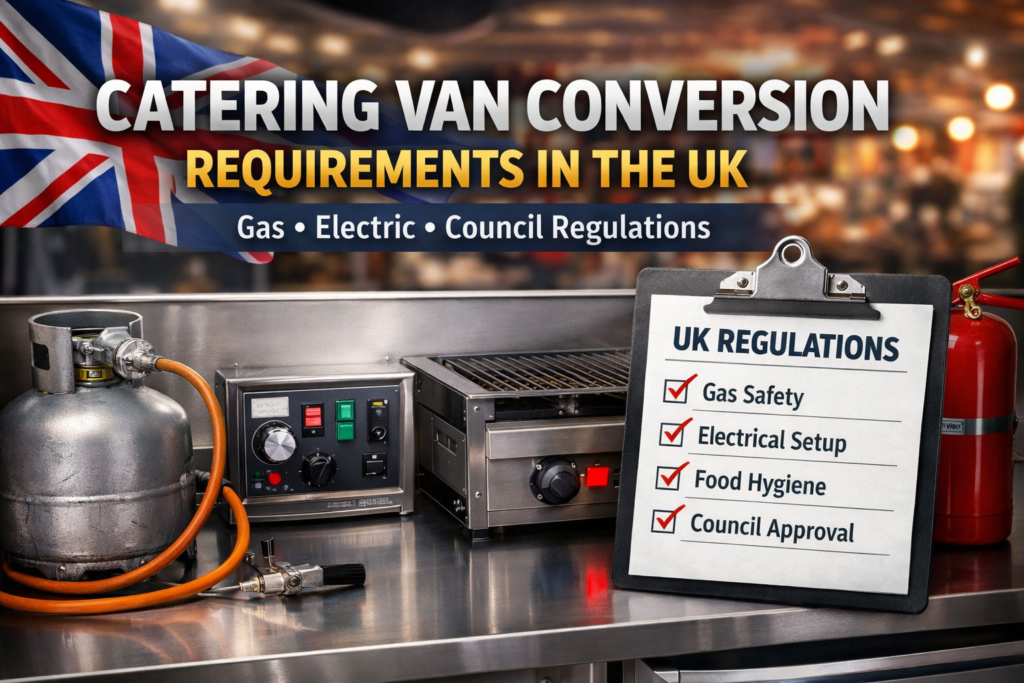
Catering van conversion requirements in the UK showing gas safety, electrical setup, food hygiene and council compliance

UK catering van conversion with gas equipment, electrical testing, fire safety and council compliance checklist

Quick checklist (the things that usually catch people out)

  • Gas system design & ventilation: safe installation, correct pipework, adequate ventilation, and suitable shut-off controls.

  • Electrical safety: a robust 12V/230V setup, appropriate consumer unit/RCD protection, and documented testing (often requested by event organisers/insurers).

  • Fire safety: correct extinguisher types, fire blanket, clear escape route, and sensible separation around cooking equipment.

  • Food safety & hygiene: cleanable surfaces, handwashing, temperature control, and sensible workflow to prevent cross-contamination.

  • Paperwork: food business registration, risk assessment, cleaning schedule, and evidence of maintenance/testing.

Who sets the rules in the UK?

There isn’t one single “catering van conversion law” — compliance is usually the result of meeting several expectations at once:

  • Your local council (Environmental Health): you register your food business with the local authority and may receive an inspection for a hygiene rating.

  • Event organisers / markets: often require proof of gas safety checks, electrical test evidence, insurance, and risk assessments.

  • Insurers: will expect a safe, professionally-considered build and may ask about gas/electrical testing and fire safety.

  • Best practice standards: while not always “law”, documented standards and competent installation reduce risk and help you trade with confidence.

1) Gas requirements for catering van conversion requirements uk (LPG)

LPG systems are one of the most scrutinised parts of a catering vehicle because failures can be catastrophic. Even if a council doesn’t explicitly demand a specific certificate, organisers and insurers often do. The safest approach is to treat gas like a professional commercial installation: correct components, competent fitting, and a system that can be checked and maintained.

Gas bottles: secure storage and sensible access

Typical expectations for LPG bottle storage include:

  • Secure restraint: bottles strapped/secured so they can’t move in transit.

  • Ventilation: LPG is heavier than air, so bottle lockers are commonly vented low to allow gas to escape outside the vehicle.

  • Protection from heat sources: keep bottles away from cooking appliances and hot surfaces.

  • Safe, practical access: so bottles can be shut off quickly and changed without unsafe contortions.

Regulators, shut-off valves and isolation

A practical commercial-style setup usually includes:

  • Correct regulator: sized appropriately for the appliances being used.

  • Isolation valves: so each appliance can be shut off independently.

  • Emergency shut-off: a clear, accessible method to stop gas supply quickly.

Pipework and appliance connections

In professional conversions, rigid pipework and correct fittings are used to reduce the risk of damage or leaks. Flexible connections (where used) should be appropriate for LPG, correctly routed, protected from heat, and not under tension. Poor routing and “temporary-looking” connections are a common reason organisers reject a pitch.

Ventilation and extraction

Gas appliances need proper ventilation and often extraction. Even when not explicitly mandated by a single rulebook, a safe build typically features:

  • General ventilation: to avoid heat build-up and maintain air quality.

  • Extraction over cooking: to remove fumes, steam, and grease-laden vapours.

  • Make-up air: so extraction doesn’t “starve” appliances of oxygen.

Gas safety checks and evidence

Even if you’re not asked on day one, you’ll often need evidence for markets and public events. Keep a folder (digital or printed) with:

  • Any gas safety documentation you have (installation details, check records, maintenance).

  • Appliance manuals and model numbers.

  • A simple diagram of the gas system (bottles → regulator → isolation valves → appliances).

2) Electrical requirements: 12V, 230V hook-up, inverters & safety

Electrics are another common “pass/fail” point for organisers and insurers. A safe catering vehicle electrical system isn’t just about powering equipment — it’s about correct protection, cable sizing, safe connections, and documented testing. Many venues want confidence that your setup won’t trip their supply or create a fire risk.

Common power setups for catering vans

  • Shore power (hook-up): 230V supply from a venue generator or mains point.

  • Onboard generator: dedicated generator supplying a consumer unit.

  • Battery/inverter system: for lighter loads or silent operation (often combined with hook-up).

What a “proper” 230V system usually includes

  • Consumer unit: with appropriate breakers and RCD protection.

  • Correct inlet and cabling: a safe external hookup point and appropriately rated cables.

  • Socket placement: away from water sources and positioned to avoid trailing leads near heat.

  • Load planning: so your total draw matches hook-up capacity (and doesn’t trip supplies mid-service).

Electrical testing: what people ask for

In the real world, many markets and event organisers ask for evidence of electrical safety. Depending on your setup, that might be:

  • PAT testing for portable appliances (kettles, fridges, etc.).

  • Periodic inspection/testing evidence for fixed wiring (especially if your system includes a consumer unit and installed circuits).

The key is: keep your paperwork organised. If an organiser emails asking for “gas & electrical certs”, you should be able to reply the same day with a single PDF pack.

3) Fire safety: equipment, layout and common requirements

Fire safety is where “good design” really matters. A catering van often contains gas, electrics, hot oil, and confined spaces — so fire risk must be designed out wherever possible.

Typical fire safety items (minimum)

  • Fire blanket: mounted accessibly near cooking.

  • Fire extinguishers: suitable types for your risks (commonly including CO₂ for electrics and a foam/powder option depending on setup).

  • Clear exit route: the door must be easy to open and not blocked by equipment/storage.

  • Heat shielding: where appliances sit close to walls/cabinets.

Ventilation and grease management

If you’re frying or cooking heavily, grease build-up is a real fire risk. A well-designed extraction system and a sensible cleaning schedule reduce that risk and improve your hygiene rating too.

4) Food hygiene requirements: what Environmental Health looks for

Environmental Health Officers (EHOs) generally want to see a setup that allows you to prepare and serve food safely. The specifics vary depending on your menu, but the underlying principles are consistent: cleanable surfaces, safe storage temperatures, hand hygiene, and separation of raw and ready-to-eat handling.

Surfaces, walls and floors

  • Easy-clean surfaces: stainless steel or food-safe, wipeable materials.

  • Sealed joins: avoid gaps and exposed timber where grease and moisture can soak in.

  • Flooring: durable and cleanable (and safe underfoot).

Handwashing and hygiene flow

A proper handwash station is often a non-negotiable. Your setup should make it genuinely easy to wash hands during service without “crossing paths” with food prep. If your workflow forces staff to reach over food or squeeze past hot equipment to wash hands, the layout needs improving.

Water and waste

You’ll typically need:

  • Fresh water storage appropriate to your service volume.

  • Waste water tanking (and a clear plan for legal disposal).

  • Safe drainage routing so leaks can’t contaminate clean areas.

Temperature control and food storage

Expect to demonstrate how you’ll keep food at safe temperatures. That usually means:

  • Refrigeration sized for your menu and service.

  • Hot holding where needed (or a plan to cook-to-order quickly).

  • Thermometers and simple temperature records.

5) Registering your food business with the council

If you sell food to the public, you normally need to register your food business with your local authority. This is separate from building the van itself, but it’s often part of your “ready to trade” checklist. Registration is typically straightforward, but don’t leave it until the week before your first event.

Tip: some traders operate across multiple locations. Make sure you understand which authority you should register with (often where the business is based, not where you trade). If you’re unsure, your local authority website usually explains the process clearly.

6) Documents you should keep (your “trading pack”)

A simple, organised pack of documents can save you a lot of friction with markets, insurers and inspections. Here’s a practical list many traders keep:

Document Why it matters

Public liability insurance

Often required by events; protects your business.

Food business registration confirmation

Shows you’re registered with a local authority.

Risk assessment

Events regularly ask for it; shows you’ve considered hazards.

Gas system records

Common request for LPG setups; supports safe trading.

Electrical testing evidence

Frequently requested by organisers; supports safe use of hook-up/generator.

Cleaning schedule

Helps hygiene ratings and keeps standards consistent.

Equipment manuals

Useful for safe operation, servicing and inspections.

7) Common mistakes that delay trading

  • Designing around equipment first, workflow second: your layout must support safe movement, handwashing, and separation.

  • Underestimating power: equipment lists grow quickly; load plan early.

  • Ventilation as an afterthought: extraction and make-up air should be planned into the build.

  • Messy cable/pipe routing: it looks unprofessional and creates hazards.

  • No paperwork: you can be “safe” but still lose pitches if you can’t prove it.

FAQ

Do I need a gas safety certificate for a catering van in the UK?

In practice, many event organisers and insurers ask for evidence that your LPG system is safe and has been checked. Requirements can vary depending on your setup and where you trade, so it’s sensible to treat gas as a professional installation and keep clear documentation of checks and maintenance.

Do I need PAT testing for my catering van?

PAT testing is commonly requested for portable appliances. If you have installed fixed wiring (consumer unit, circuits, hook-up), you may also be asked for evidence of electrical testing/inspection. Either way, having a tidy “trading pack” makes approvals much easier.

Do councils inspect catering vans?

When you register a food business, an Environmental Health inspection may take place depending on local policy and risk factors. The inspection focuses on hygiene and food safety controls: cleanliness, layout, temperature control, handwashing, and safe procedures.

What’s the fastest way to avoid compliance problems?

Plan compliance into the design from day one: ventilation, workflow, safe storage, sensible electrics and proper fire safety. Then keep your documentation organised so you can satisfy organisers and insurers quickly.

Need help planning a compliant catering van conversion?

If you’re comparing quotes or planning your first build, the easiest way to avoid costly mistakes is to map your menu, workflow, equipment list and compliance needs before the conversion starts. If you’d like, you can speak to us about your layout and requirements and we’ll advise on the most practical route to a safe, trade-ready build.

Related reading:
How Much Does a Catering Van Conversion Cost in the UK?
|
Catering Van Conversions
|
Talk to us about your project


 Find Us on Map

Catering van conversion cost UK is one of the most common questions we’re asked — and the honest answer is: it depends on how you plan to trade, what equipment you need, and the level of finish required.

The short answer is — it depends. The longer (and more useful) answer depends on how you plan to trade, what equipment you need, and the level of finish required.

In this guide, we break down the real costs of a catering van conversion in the UK, what affects the price, and how to budget properly for your mobile catering business.

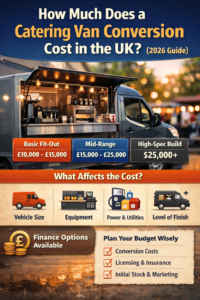
Catering van conversion cost UK infographic showing basic, mid-range and high-spec build prices with factors affecting cost.

Infographic explaining catering van conversion cost in the UK, including price ranges for basic, mid-range and high-spec builds and key cost factors.

Average Catering Van Conversion Costs in the UK

As a general guide, catering van conversion costs in the UK typically fall into the following ranges (excluding the base vehicle):

Build Type Typical Conversion Cost Best For
Basic fit-out £10,000 – £15,000 Start-ups with a simple menu and minimal equipment
Mid-range professional conversion £15,000 – £25,000 Most traders who need reliability, compliance and a practical layout
Fully bespoke, high-spec build £25,000+ Brand-led businesses needing premium finish and specialist equipment

These figures usually exclude the base vehicle, which can be supplied by the customer or sourced separately.

What Affects the Cost of a Catering Van Conversion?

No two builds are the same. The final price is influenced by several key factors:

1) Vehicle Size & Layout

Larger vehicles allow more equipment and workspace but typically require more materials, larger extraction, and higher electrical and gas capacity. A compact van may be more affordable, but it can limit workflow and service speed during busy trading periods.

2) Equipment Requirements

Your menu has a huge impact on cost. Equipment such as griddles, fryers, pizza ovens, coffee machines, refrigeration, bain-maries and hot cupboards can all affect price. Higher-output or specialist equipment increases both purchase and installation costs.

3) Power, Gas & Water Systems

A compliant catering vehicle requires properly installed electrical systems, gas installations, and fresh/waste water systems. These must meet UK safety standards and are a major part of any professional conversion.

4) Extraction & Ventilation

If you’re cooking inside the van, extraction is often one of the most important (and costly) parts of the build. The specification depends on your cooking method, heat output, and internal layout — and it’s also critical for inspections and safe day-to-day trading.

5) Level of Finish & Branding

A functional build and a premium branded unit are very different. Basic stainless steel finishes, custom cabinetry, feature lighting, and branded serving hatches can improve customer perception — but they will increase build cost.

Cheap vs Professional Catering Van Conversions: What’s the Difference?

It can be tempting to choose the cheapest quote — but low-cost conversions often lead to problems later. Budget builds may cut corners on compliance, use unsuitable materials, cause inspection failures, and require costly rework.

A professional catering van conversion is designed to pass inspections, trade reliably and last, which typically makes it better value long-term.

Can You Finance a Catering Van Conversion in the UK?

Yes — many businesses choose to spread the cost using catering van finance. Finance can help you preserve cash flow, launch sooner, budget with fixed monthly payments, and invest in a higher-quality build.

For many operators, the vehicle becomes a revenue-generating asset from day one, making finance a practical option for launching or upgrading a mobile catering business.

Explore catering van finance options.

How to Budget for Your Catering Van Conversion

When planning your budget, consider the full picture, not just the build cost:

  • Conversion cost
  • Equipment specification
  • Branding, signage and wrap
  • Insurance and licensing
  • Gas safety checks and electrical certification (where applicable)
  • Initial stock, packaging and marketing
  • Contingency fund for unexpected extras

A clear brief and realistic budget help avoid surprises and ensure your vehicle supports long-term success.

catering van conversion cost UK FAQs

How much does a catering van conversion cost in the UK?
Most catering van conversions in the UK cost between £10,000 and £25,000+, depending on equipment, finish, compliance requirements and vehicle size.

Does the price include the van?
Usually not. Conversion quotes typically exclude the base vehicle unless you’re purchasing a complete package that includes vehicle supply.

Are catering van conversions worth the investment?
A professionally built catering van is compliant, reliable, and designed to trade daily — making it a long-term business asset.

Can I finance a catering van conversion?
Yes. Many operators finance the conversion to spread the cost, keep cash available for trading, and launch sooner with manageable monthly payments.

Final Thoughts

A catering van conversion is not just a vehicle — it’s your business on wheels. Understanding the true costs helps you make informed decisions, avoid shortcuts, and invest in a build that supports how you trade.

If you’re considering a catering van or food truck conversion, speaking to an experienced builder early in the process can save time, money and stress.

Ready to Start Your Build?

If you’d like to discuss a catering van conversion or explore finance options, contact our team to talk through your requirements. If you already have a vehicle in mind, share the make/model, your menu, and your ideal layout — and we’ll guide you on the most practical specification for your budget.

Contact our team
or view our catering van conversions.

We work with Aureum Finance to offer flexible funding options.